
4 min read
By Dr. Maria K. Jimmy
Five more minutes…
We tell ourselves.
In those five minutes we see: a wedding proposal, war scenes, a recipe you’d want to try, a funny meme, a parent speaking about their child’s illness, a skincare ad, someone’s success, a political argument…. And a lot more.
Think about it:
What does this constant social media scrolling do to our brains?
To be clear: social media isn’t evil. It keeps us connected, informs us about global events, introduces us to new ideas, and even builds communities.
But too much of anything, even something good, comes with a cost.
And the way we’re consuming it today… our brains were never built for this.
We Were Never Meant to Consume This Much
Humans evolved for small communities. We once knew only our village. Back then news travelled slowly, and we had time to process emotions.
Today we experience hundreds of people’s lives every day, including the nitty gritty details. While it is good to stay informed, it’s also something we need to keep track of.
The World Health Organization has defined this phenomenon as an “infodemic”—an overabundance of information that can contribute to anxiety, worry and other mental health issues because of its quantity, accessibility and visibility everywhere.
In short, our brains are trying to keep up with a world they were never designed to experience.
Emotional Whiplash
Laughing → crying → outrage → inspiration → shopping.
Constant emotional switching means we never fully process any emotion.
Psychologists call the result “compassion fatigue,” the gradual dulling of empathy from overexposure. We used to grieve selectively: a neighbour’s loss, a community’s tragedy.
Now we are drowning in multitudes of grief that we cannot hold, and our survival instinct tells us to look away. The brain is only trying to protect itself, but in a way we are being desensitised to horrible things.
The Illusion of Productivity
We watch productivity hacks, psychology, medicine, finance, cooking, travel. Yet we don’t really do any of those which we “save” in our folder.
Consumption feels like achievement, but knowing isn’t doing.
Researchers found that repeated exposure to highly stimulating, fast-paced content may contribute to habituation, where users become desensitised to slower, more effortful cognitive tasks such as reading, problem solving, or deep learning.
Your Attention Is Being Trained
You might have heard this line so many times: Your attention span is getting ruined.
Actually, our attention span is being trained.
Endless novelty, short videos, instant rewards, and constant stimulation—that’s what we are being subjected to, in a single session of scrolling.
Psychologist Gloria Mark‘s research has shown that over the past couple of decades people’s attention spans have shrunk in measurable ways. We spend an average of just 47 seconds on any screen before shifting our attention, and it takes 25 minutes to bring our attention back to a task after an interruption.
Reading books, painting, conversations, studying, sitting in nature—these now feel “boring.”
Children growing up in an age where scrolling has become the default response to boredom may find it very difficult to engage with slower activities. They find it hard to flip through a book, or even sit still for a while.
Well, our brains expect constant stimulation. And that’s the training we are giving.
The Dopamine Trap
I’ve had a long day. I deserve some “me time”. So we scroll.
More often than not, we’re looking for relief rather than information. Every swipe promises: maybe the next reel will give me what I want, or the next one.
Before you realise, 45 minutes have disappeared. You don’t feel rested. In fact you feel mentally fuller.
Researchers have noted that the continuous cycle of swiping and receiving new, emotionally stimulating content has been proposed to trigger dopamine release, creating a reinforcement loop that contributes to patterns of habitual use.
This habitual engagement may be associated with heightened stress and anxiety, as some users report difficulties disengaging and regulating their emotions in offline settings.
It Steals More Than Time
Phones have made boredom increasingly rare. But they may also be removing the space where our minds breathe.
Scrolling costs walks, sunsets, conversations, hobbies, books, silence, boredom, creativity, noticing your surroundings. Being bored is where ideas form and creativity blooms.
Sleep: The Hidden Casualty
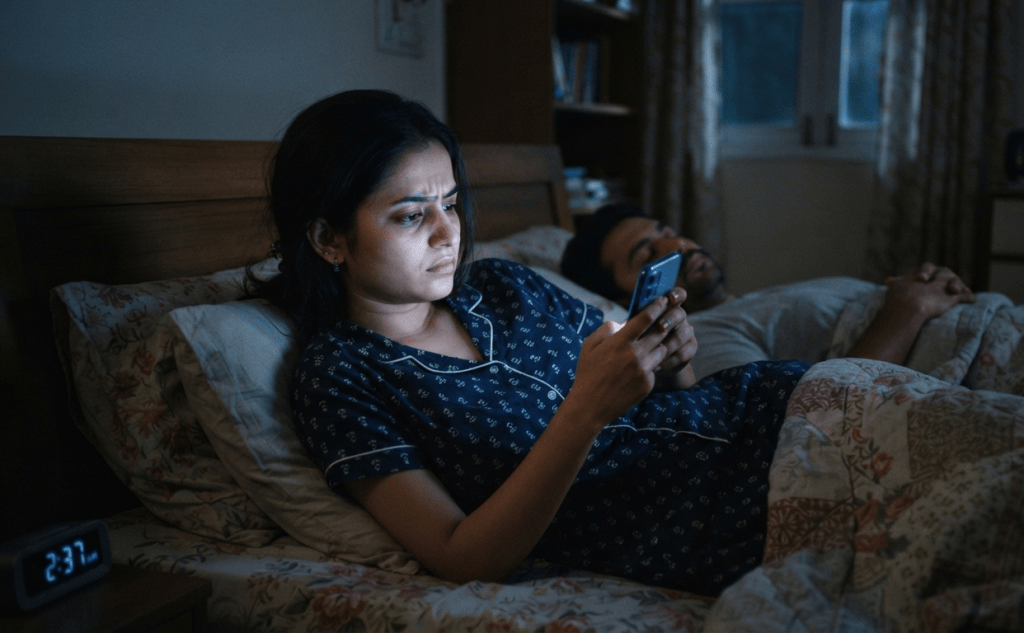
Before you sleep you get some free time. But instead of resting, you consume more. Your body lies in bed, while your mind keeps scrolling.
According to several studies, adults who use their phones before bed to view news and current events tend to sleep slightly or significantly worse. Research recommends that adults get at least seven hours of sleep per night and avoid blue light from handheld electronics 30–60 minutes before bedtime.
Yet most adults prioritise phone screen time over getting the recommended amount of sleep.
Scientists warn that blue light, especially when paired with emotionally charged content, can trick our internal clocks into daytime alertness, throwing our natural sleep cycle completely out of sync.
So… Is Instagram the Villain?
No.
Social media, at its best, is a window to the world.
It lets us witness history, learn skills we’d never otherwise discover, find support in strangers, and laugh together across continents. It has democratised knowledge and given voices to the voiceless.
That’s real, and it matters.
But the problem isn’t the tool; it is the unchecked, passive, endless consumption of it: scrolling mindlessly for relief, swiping out of boredom, and letting an algorithm decide what we feel, fear, and desire.
We should learn to use social media sparingly and intentionally:
- Follow the people who teach you
- Mute what drains you, and stay away from ‘brainrot’ content
- Set timers in the app to help you monitor your usage
- Remember to close the app when your thumb starts moving on its own
Social media can be a wonderful thing. But only if you are the one holding the phone, and not the other way around.
So the real question remains: are you using it, or is it using you?
References & Further Reading
- American Academy of Sleep Medicine (AASM)
- National Institute of Mental Health and Neurosciences (NIMHANS), Bengaluru
- American Psychological Association (APA)
- Gloria Mark. Attention Span: A Groundbreaking Way to Restore Balance, Happiness and Productivity (2023)
- Figley CR. Compassion Fatigue: Coping with Secondary Traumatic Stress Disorder in Those Who Treat the Traumatized. Brunner/Mazel (1995)
- Meshi D, Tamir DI, Heekeren HR. The Emerging Neuroscience of Social Media. Trends in Cognitive Sciences (2015)
- World Health Organization (WHO). Managing the COVID-19 Infodemic
Image Note: The accompanying image is an AI-generated illustration.
You may wish to read these next:

