
3 min read
21/3. A date that symbolises Trisomy 21 — three copies of chromosome 21. From first periods and puberty to menopause, gynaecological and reproductive health in women with Down syndrome deserves informed, comprehensive care.
By Dr. Maria K. Jimmy
We celebrate the first steps. We cheer the first words.
We mark every milestone our children with Down syndrome achieve with joy and relief.
But we do not talk about the first period.
We remain silent about menstrual hygiene, sexual health, fertility, and menopause. For women with Trisomy 21, this silence carries real consequences.
Let us break the taboo and discuss the forgotten woman: her body, her cycles, and her right to comprehensive healthcare.
The Red Flag Arrives: Navigating Menarche
For a girl with Down syndrome, the first period (menarche) arrives at roughly the same age as her peers, around 12 to 13 years.
However, it presents unique challenges that can make the experience of bleeding confusing or even frightening:
- Hypotonia (low muscle tone)
- Sensory processing differences
- Intellectual disability
The responsibility of teaching menstrual management to a child with intellectual disabilities often falls entirely on mothers, many of whom receive little to no guidance from the medical community.
The Myth of Infertility: Yes, She Can Conceive
Here is the medical truth that history got wrong: women with Down syndrome can and do become pregnant.
The assumption of infertility has had serious consequences. Because of this misconception, many girls and women with Down syndrome receive little to no sexual health education, contraception counselling, or reproductive health guidance.
This lack of education increases the risk of abuse, unintended pregnancy and confusion about their own bodies.
And then come the uncomfortable questions.
How do we approach contraception in a woman with intellectual disabilities?
Who decides? A parent? A doctor? The woman herself?
The push for autonomy must be balanced with protection. But history shows that we have often tipped too far towards control.
There are documented cases of coerced sterilisation — decisions shaped more by prejudice than by ethical and patient-centred care.
The Fast-Forward Button: Early Menopause
For many women with Trisomy 21, reproductive ageing moves faster. Studies indicate that women with Down syndrome experience menopause earlier, often entering perimenopause in their early 40s.
This early oestrogen withdrawal carries important consequences:
- Bones weaken faster, increasing the risk of osteoporosis and fractures
- Mood swings and cognitive changes intensify, often blamed solely on Trisomy 21 or early dementia.
- Hormonal causes are missed, delaying timely gynaecological care for early menopause
The Screening Gap: Cervical Health in Down Syndrome
Cervical cancer screening is uncomfortable for many women.
For a woman with Down syndrome — especially one with sensory sensitivities, anxiety, or communication challenges — a Pap smear can feel overwhelming and distressing.
Consequently, cervical cancer screening rates remain low in women with Down syndrome. However, their risk of HPV and cervical cancer is real.
The solution is a protocol shift with practical changes:
- Desensitisation sessions before the appointment
- Trusted caregivers present during the procedure
- Longer consultation times
- Reasonable adjustments within the clinic
The Caregiver’s Burden: The Mother in the Mirror
Finally, let us speak about the caregiver — the steady presence beside a woman with Down syndrome.
She may be a mother in her middle or older years, managing her own menopause, hypertension, or diabetes.
Or she may be a guardian, an aunt, an older sister.
Yet she remains the primary caregiver, guiding her through menstrual health, reproductive care and even early menopause in Trisomy 21.
This is the quiet reality of caregiving in Down syndrome: caring for another while quietly carrying your own struggles.
While navigating her own health concerns, she continues to coordinate medical appointments, manage periods, monitor medications, and support emotional wellbeing.
It is exhausting — and rarely acknowledged.
Caregiver stress in families of women with Down syndrome is real, even when it goes unseen. Behind every prescription and clinic visit stands someone carrying quiet responsibility. Beyond medicines and clinic visits, caregivers need support, rest, and a doctor who pauses and asks,
“And how are you doing?”
Beyond Milestones: Caring for the Whole Woman
Women with Down syndrome grow up. They have periods, they navigate relationships, they experience menopause, and their bodies change just like anyone else’s.
Their gynaecological and reproductive healthcare needs do not end with childhood.
Comprehensive care in Trisomy 21 must include the following:
- Menstrual health
- Contraception counselling
- Cervical cancer screening
- Support for caregivers
Most of all, it must include listening.
Breaking the silence begins with recognising that women with Down syndrome are whole individuals — deserving of dignity, autonomy, and lifelong, respectful healthcare.
Resources and Notes
- Kliegman RM, St. Geme JW. Nelson Textbook of Pediatrics. 21st ed. Elsevier; 2020.
- Down’s Syndrome Association (UK). Women’s Health and Wellbeing. 2022.
- National Down Syndrome Society (NDSS). Sexuality and Down Syndrome: A Guide for Parents. 2023.
- Indian Journal of Medical Research. Burden of care in families of children with intellectual disability. 2021.
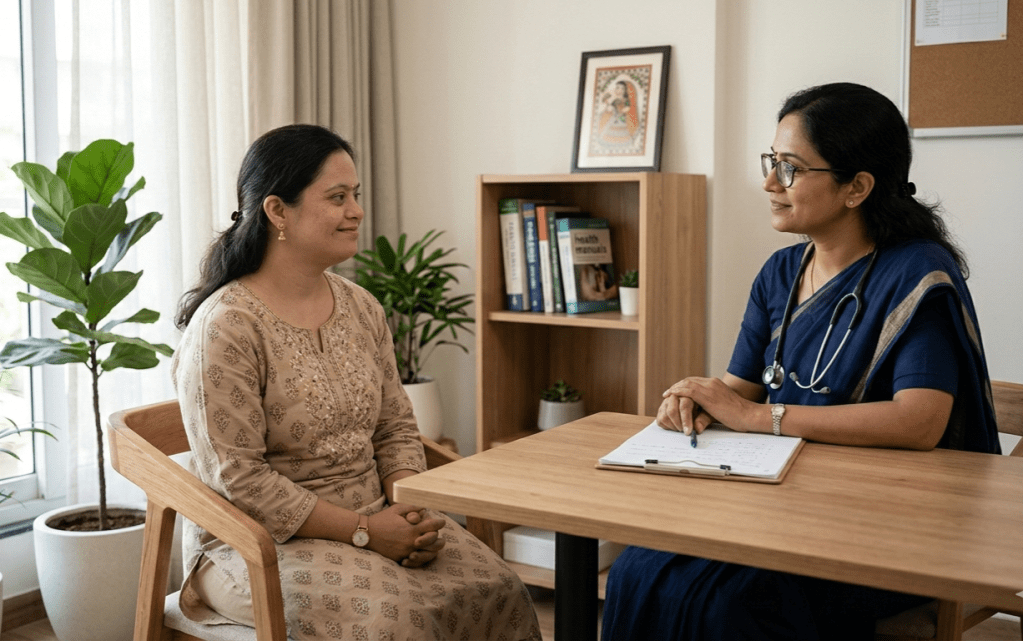
Image Note: The accompanying image is AI-generated. No real individuals are depicted.
You may wish to read these next:
 Dr. Maria K. Jimmy