
3 min read
With World Sleep Day approaching, it is worth asking an uncomfortable question: is your nightly scrolling quietly sabotaging your sleep quality?
By Dr. Maria K. Jimmy
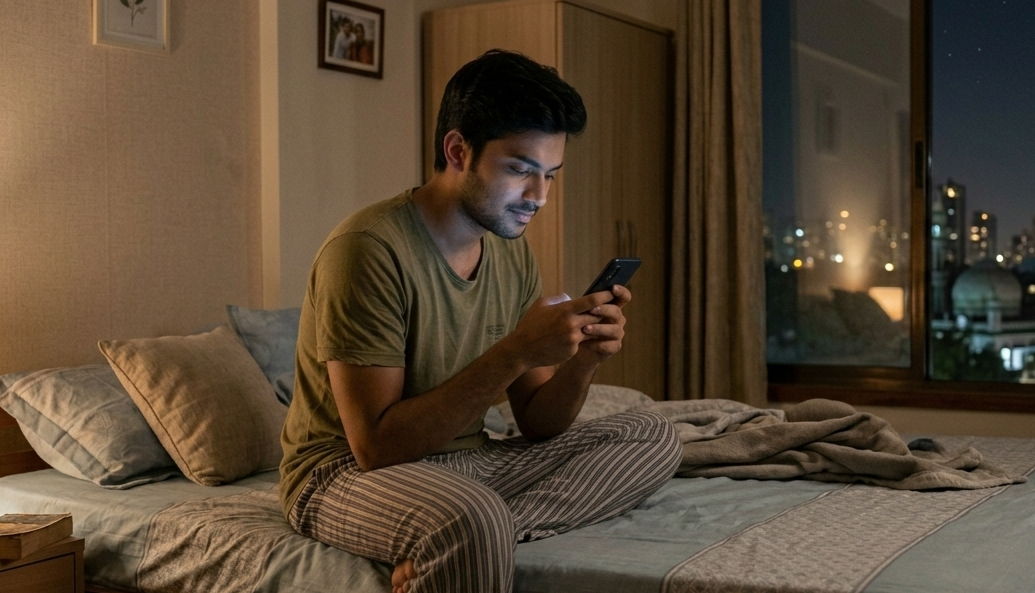
We have all been there.
You slip into bed, exhausted, promising yourself you will close your eyes after “five minutes” of scrolling. An hour later, you are still watching reels, reading comments, or tumbling down a news rabbit hole. It feels like a harmless way to unwind, doesn’t it?
As someone still working on this myself, I can confirm this habit has an impressive talent for stealing restorative sleep and reducing overall sleep quality.
So what is actually happening in your brain when you scroll before bed? Are you wondering how to improve sleep naturally?
Let’s look at the science and why putting the phone down might be one of the kindest decisions you make for your health today.
Your Body’s Internal Clock Runs on Darkness
Your body operates on a 24-hour clock called the circadian rhythm. This internal conductor orchestrates everything from hormone release to body temperature to sleep-wake cycles.
When darkness falls, your brain’s pineal gland releases melatonin — the hormone that gently signals, “It’s time to wind down.”
But when you are scrolling past midnight, that blue light from your screen hits your retina and tricks your brain into thinking it is still daytime. This suppresses melatonin production via the suprachiasmatic nucleus, keeping your brain artificially alert.
The effects of screen time on sleep are especially pronounced when exposure happens at night.
And that’s just the beginning of the story.
The Sleep-Gut Connection You Never Expected
This is where it becomes fascinating.
Your gut has its own nervous system, often referred to as the “second brain”. Like your brain, it follows a circadian rhythm. The trillions of bacteria living in your intestines, collectively known as the gut microbiome, operate on their own internal clocks.
When you scroll before sleep, each upsetting headline triggers the release of cortisol, keeping your body in a state of alertness. Elevated stress hormones do not just affect your mind. They also disturb the balance of your gut microbiome, contributing to inflammation, bloating and digestive discomfort.
The crucial link is this:
Around 90–95% of the body’s serotonin, the neurotransmitter responsible for stabilising mood and regulating sleep, is produced in the gut. When your gut rhythm is disrupted, your mood regulation and sleep quality are affected as well.
Where Your Energy Goes at Night
Now let’s talk about the third piece of the puzzle: energy.
You know that groggy feeling in the morning, after a night of late scrolling?
That fogginess is your body missing out on deep sleep — the phase where physical repair happens. Over time, this pattern leads to poor sleep quality, even if you spend enough hours in bed.
During deep sleep, your body repairs tissues, consolidates memories, and clears out metabolic waste through a process known as the glymphatic system.
When scrolling delays or fragments your sleep cycle, you rob yourself of this restoration.
The elevated cortisol that accompanies stressful night scrolling raises blood sugar, increases abdominal fat storage, and leaves you feeling drained the next day.
Unknowingly, you are priming your body for stress while trying to rest.
Losing Sleep Over Losing Sleep
Here is how it unfolds in real life:
Poor sleep → Disrupted gut bacteria → Reduced serotonin → Lower mood → Increased stress → Even worse sleep
It becomes a self-perpetuating cycle.
Chronic sleep deprivation amplifies this cycle further. And this circadian misalignment often begins with that seemingly harmless nightly habit that disguises itself as relaxation.
Reclaiming the Day: Revenge Bedtime Procrastination
Why do we do it? Why keep scrolling when our eyes are burning?
It is called revenge bedtime procrastination — the sense that the day was swallowed by work, responsibilities and endless demands.
At night, we try to reclaim control. We scroll in search of something: a laugh, a connection, a fragment of good news, or simply a small dopamine lift that says,“This day was not entirely obligation.”
We want to end the day on a note that feels like ours. Ironically, in chasing that fleeting sense of reward, we sacrifice the sleep that would actually restore us.
Your sleep, gut and energy are not separate problems. They are parts of one interconnected system. And your late-night scrolling habit pulls all three in the wrong direction.
Sleep Hygiene Tips to Break the Late-Night Scrolling Cycle
1. The One-Hour Rule
Commit to zero screens for at least 60 minutes before bed.
This is not arbitrary. Your brain needs this time to reduce stimulation, lower cortisol and produce adequate melatonin for healthy sleep onset.
2. Create Physical Distance
Put your phone outside the bedroom.
If you rely on it as an alarm, switch to a basic alarm clock. When the device is not within reach, impulsive scrolling becomes far less likely.
3. Follow the 3-2-1 Guide
A simple structure to fix your sleep cycle that supports both gut and brain health:
- 3 hours before bed: Stop eating to allow digestion to settle and support your gut microbiome.
- 2 hours before bed: Stop working to reduce cognitive stimulation.
- 1 hour before bed: Stop screens to protect melatonin production and circadian rhythm.
4. Replace Scrolling with a Wind-Down Ritual
Replace the smartphone-before-bed habit with healthy sleep habits.
- Read a physical book.
- Try gentle stretching.
- Journal briefly.
- Practice five minutes of slow breathing.
These activities signal safety to your nervous system, lower cortisol and prepare your body for restorative sleep.
5. Protect Your Light Environment
Dim overhead lights in the evening and switch to warmer lighting after sunset.
Your brain reads light as information. Softer lighting tells it that night has begun.
6. Anchor Your Wake-Up Time
Even more important than bedtime is a consistent wake-up time.
Morning light exposure within 20–30 minutes of waking strengthens your circadian rhythm and makes it easier to fall asleep naturally at night.
Sleep On This: The Reset You Deserve
Consider this your wake-up call to put your phone down at night.
Your brain will reward you with deeper rest. Your gut will respond with calmer digestion. Your energy will show up in the morning feeling genuinely recalibrated.
What could be better than waking up well-rested, with a freshness you have not experienced in a long time?
Further Reading & Notes
- Hall JE, Hall ME. Guyton and Hall Textbook of Medical Physiology. 14th ed. Elsevier; 2021.
- Kryger MH, Roth T, Goldstein CA. Principles and Practice of Sleep Medicine. 7th ed. Elsevier; 2022.
- Xie L, Kang H, Xu Q, et al. Sleep drives metabolite clearance from the adult brain. Science. 2013;342(6156):373–377.
- West KE, Jablonski MR, Warfield B, et al. Blue light suppresses melatonin in humans. Journal of Applied Physiology. 2011;110(3):619–626.
- Thaiss CA, Zeevi D, Levy M, et al. Transkingdom control of microbiota diurnal oscillations promotes metabolic homeostasis. Cell. 2014;159(3):514–529.
Article Note: This article is grounded in established medical literature and clinical understanding, with reflective insights drawn from lived experience.
Image Note: Image is AI-generated for illustrative purposes to represent late-night screen use. No real individual is depicted.
You may wish to read these next:
 Dr. Maria K. Jimmy