
4 min read
SPF science explained with practical sunscreen recommendations for oily, dry, sensitive, and pigmentation-prone skin
By Dr. Maria K. Jimmy
In a hurry? Jump straight to the sunscreen picks.
Sunscreen seems simple.
Check the SPF on the label. Apply. Done.
But what if everything you believe about sun protection is quietly sabotaging your skin?
Understanding SPF 50 vs SPF 100, UVA protection, and daily sunscreen use is far more complex than most people realise.
Let’s crack open the myths.
Myth 1: SPF 100 vs SPF 50
“SPF 100 gives double the protection of SPF 50.”
The Science:
SPF measures UVB protection logarithmically, not linearly.
- SPF 50 blocks ~98% of UVB.
- SPF 100 blocks ~99%.
The Reality:
You are paying more for 1% extra, and it barely changes the level of protection.
Application thickness affects protection far more than the number on the bottle. Most people apply less than half the required amount (roughly three finger lengths).
An SPF 50 applied generously outperforms an SPF 100 applied sparingly, every time.
Myth 2: Sunscreen on Cloudy Days
“Sunscreen is only for the outdoors and sunny days.”
The Science:
The key factor is UVA radiation. Unlike UVB (burning rays), UVA penetrates glass and clouds. It reaches the dermis, where it breaks down collagen and elastin.
The Reality:
Sitting beside an office window for years creates unilateral photodamage. Truck drivers famously show more aging on their left side.
Cloud cover reduces UVB more than UVA, which is why pigmentation and photoageing continue even on cloudy days.
Daily sunscreen is essential, come rain or shine.
A broad-spectrum SPF 50+ protects against both UVA and UVB damage.
Myth 3: Our Grandparents Didn’t Use Sunscreen
“Our grandparents never used sunscreen and they were fine.”
The Science:
Were they? Or did we simply not recognise what sun damage looked like?
The Reality:
- The older generations had a much shorter lifespan. Sun damage builds up slowly and often takes decades to show.
- Many people worked outdoors daily, creating a different exposure pattern than today’s intense, intermittent holiday sunburns.
- Formal skin cancer registries were also limited two generations ago. We are not comparing the same conditions or the same data.
- Photoageing, pigmentation, and even skin cancers were often under-recognised.
Myth 4: Sunscreen and Vitamin D
“Sunscreen causes vitamin D deficiency.”
The Science:
This is physiologically unlikely.
Sunscreen reduces UVB exposure; it does not eliminate it completely. Current evidence suggests that typical real-world sunscreen use does not meaningfully impair vitamin D levels.
The Reality:
Even SPF 50 still lets in enough UVB for most people to make adequate vitamin D. And here’s the twist: vitamin D deficiency is common even in people who rarely, or never, use sunscreen.
Brief incidental exposure, dietary sources, and targeted supplementation (such as vitamin D and B-complex where indicated) are far safer and more reliable than intentional sunburn.
Myth 5: Sunscreen for Oily Skin
“People with oily or acne-prone skin should avoid sunscreen.”
The Science:
Older sunscreen formulations were often heavy and occlusive, which could clog pores. Modern sunscreens, however, are lightweight, oil-free, and non-comedogenic.
The Reality:
Sun exposure stimulates melanin production, which deepens those stubborn brown spots after a pimple heals. Daily use actually helps prevent post-acne pigmentation by reducing UV-induced darkening of marks.
Myth 6: Waterproof Sunscreen
“Waterproof sunscreen lasts all day.”
The Science:
“Water-resistant” is a regulated term. It means the SPF holds for 40 or 80 minutes in water — not all day, and not after towelling.
The Reality:
Reapplication every 2-3 hours, and immediately after swimming or sweating, remains essential.
In fact, the FDA no longer allows the term “waterproof” because it creates a false sense of security.
Myth 7: Makeup with SPF
“Makeup containing SPF is enough.”
The Science:
Foundation with SPF 30 sounds adequate. But reaching that protection requires a thick layer — far more than most people apply.
The Reality:
Layering matters. Think of makeup SPF as supplementary, not as your main shield.
Use a standalone sunscreen underneath, then build makeup over it.
How to Choose the Right Sunscreen for Your Skin Type (Doctor-Approved Guide)
Now that we have cleared the sunscreen myths, the next step is simple: choose wisely and use it correctly.
Choosing a sunscreen should not feel overwhelming, but with countless options lining the shelves, it is easy to get confused.
The right sunscreen is the one that:
- suits your skin type
- addresses your specific concerns
- feels pleasant enough for you to apply generously every single day
Best Sunscreens by Skin Type: Science-Backed Picks (With Links)
Best Sunscreen for Oily or Acne-prone skin
Oily skin needs oil control without clogging pores.
Look For:
- Lightweight gel or fluid texture
- Dry-touch or matte finish
- Non-comedogenic formula
- SPF 50+ with strong UVA protection
RECOMMENDED BUYS for Oily skin:
- Happier Ultralight Sunscreen Gel
- UV Doux Silicone Sunscreen Gel
- Deconstruct Gel Sunscreen
- The Derma Co 1% Hyaluronic Matte Gel Sunscreen
Why They Work:
Lightweight gels absorb quickly, reduce shine, and minimise congestion while protecting against post-acne pigmentation.
Best Sunscreen for Dry Skin
Dry skin needs hydration and barrier support along with high UV protection.
Look For:
- Cream or lotion-based texture (reduces transepidermal water loss)
- SPF 50+ with broad-spectrum protection (prevents UV-induced barrier damage)
- Humectants like glycerin or hyaluronic acid (draw moisture into the skin)
- Barrier-supporting ingredients like ceramides, panthenol, niacinamide (strengthen the skin barrier)
Avoid (or Use With Caution):
- High alcohol content → can worsen dryness and weaken the barrier.
- Strongly matte, oil-control formulas → may increase tightness and flaking.
Budget Buys for dry skin:
Slightly Premium Buys for dry skin:
Why These Work:
Cream-based formulas reduce water loss and support the skin barrier while providing strong UVA and UVB protection. When sunscreen feels moisturising, daily use improves, and consistency is what protects skin long term.
Best Sunscreen for Pigmentation-Prone & Sensitive Skin
Look For:
- Tint with iron oxides (helps protect against visible light, which may worsen pigmentation)
- SPF 50+ with PA+++ or higher (strong UVA/UVB defence)
- Zinc oxide or titanium dioxide (gentle mineral filters)
- Photostable filters (enhanced long-wave UVA protection)
- Barrier-supporting ingredients (improves tolerability)
Use With Caution:
- Fragrance or essential oils
- Oxybenzone / benzophenone filters
- Very high alcohol content in barrier-compromised skin
- Strong exfoliating acids in the same formula
Budget Buys for pigmentation-prone & sensitive skin:
Premium Buys for pigmentation-prone & sensitive skin:
What’s Extra: Advanced photostable UVA1 filters for superior long-wave UVA protection.
Your Skin Will Remember What You Do Daily
Ultimately, the best sunscreen is the one you will apply generously and reapply consistently. Like many small daily habits, consistency matters more than perfection.
Over time, that habit protects your collagen, preserves your skin barrier, and makes the real difference.
References & Notes:
- Kang S et al. Fitzpatrick’s Dermatology. 9th ed. McGraw-Hill.
- Teramura T et al. Relationship between sun-protection factor and application thickness. Clin Exp Dermatol. 2012.
- Indian Sunscreen Forum (PRISM-ISF). Practical recommendations for sunscreen use in India: A modified Delphi consensus. J Cosmet Dermatol. 2025.
- Young AR et al. Optimal sunscreen use, vitamin D status and sun exposure. Br J Dermatol. 2019.
- Mahmoud BH et al. Impact of long-wavelength UVA and visible light on melanocompetent skin. J Invest Dermatol. 2010.
Product Note: Recommendations are based on independent review and clinical experience. Individual responses vary. Always review ingredients and patch test before regular use.
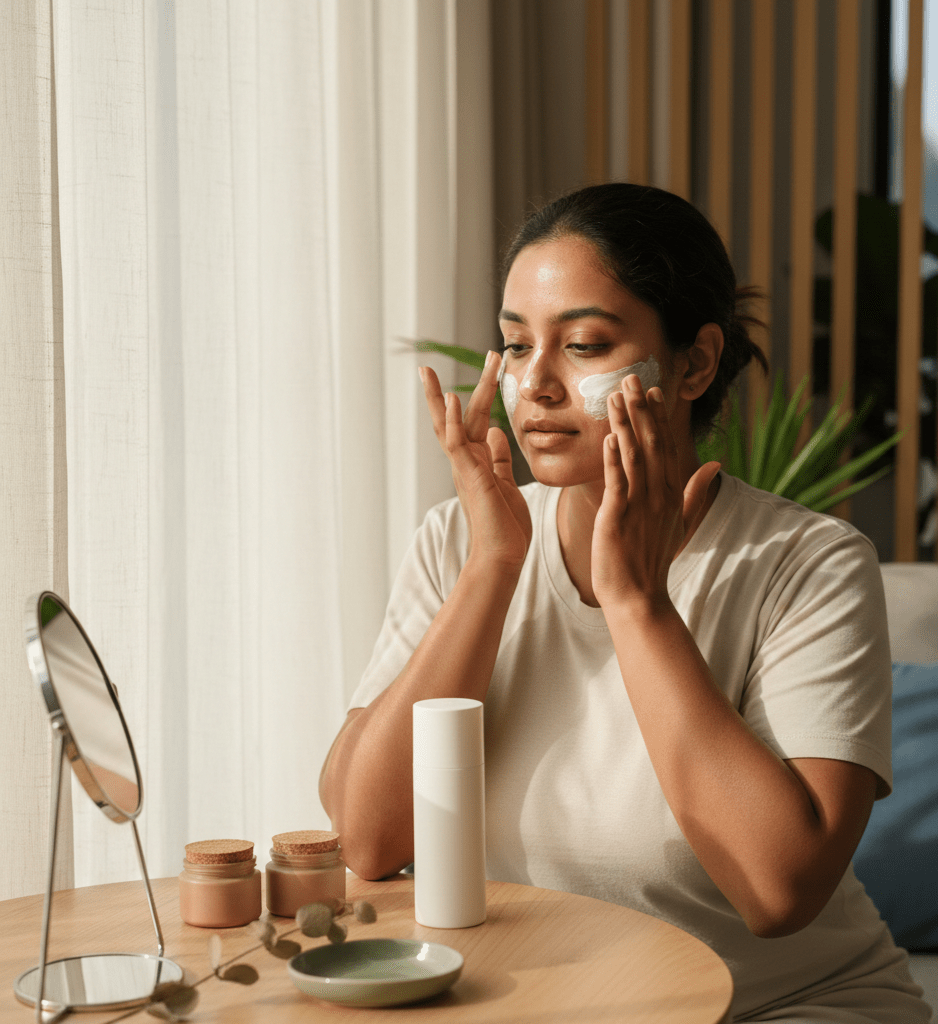
Image Note: The image is AI-generated and created to support discussion on sunscreen myths and sun protection science. It does not depict a real person.
You may wish to read these next:
 Dr. Maria K. Jimmy